
The graduation gown order process: 7 stages from enquiry to delivery
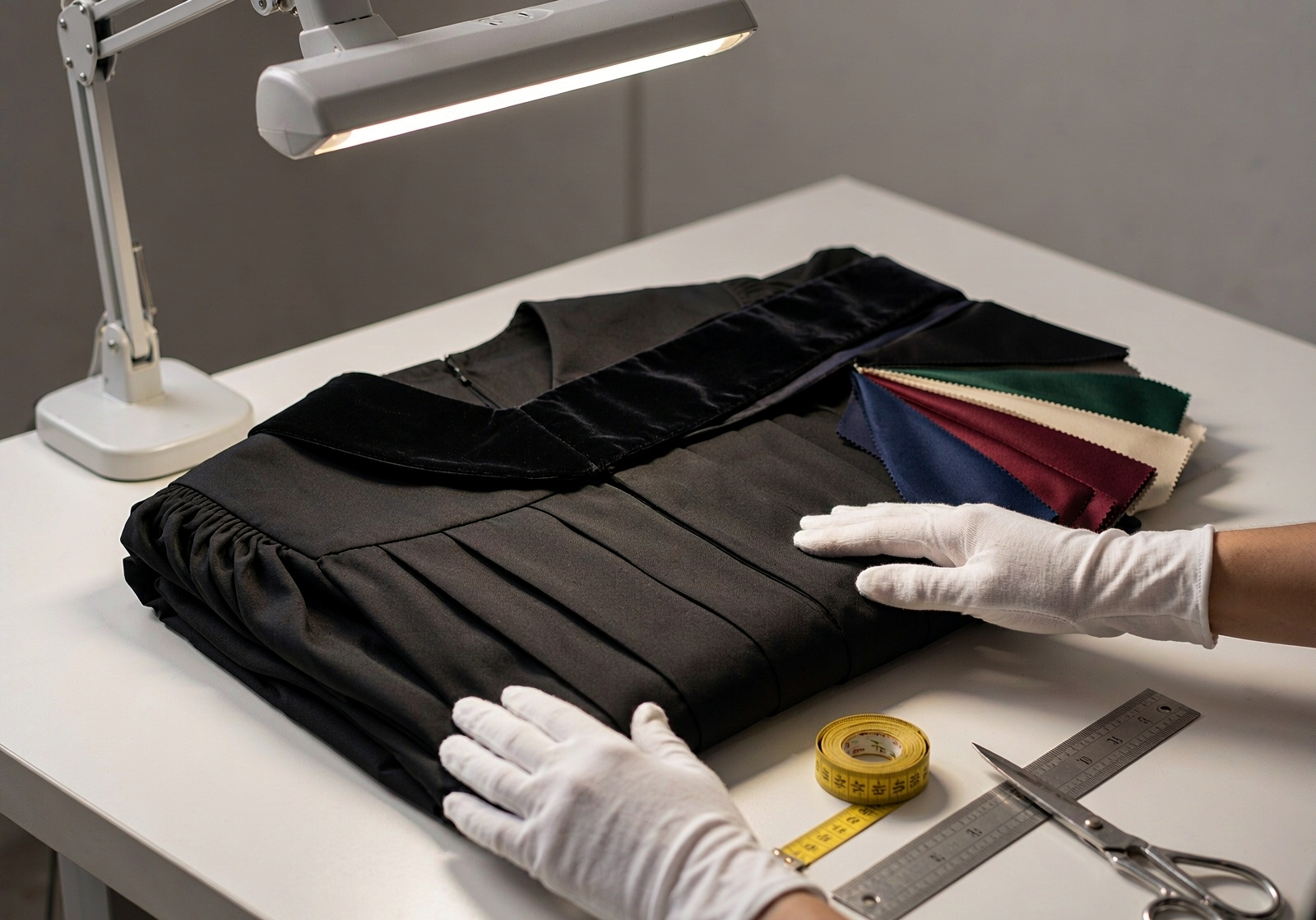
Seven stages sit between your enquiry and the delivered goods, and a stall in any one of them pushes the date. The full process, the eight items a quote actually needs, real sampling and production timings, and the five steps buyers most often skip.
Whether a graduation regalia order runs smoothly is decided long before the first stitch. The failures are rarely in the sewing: they come from a buyer who believed they had been clear and a factory that believed it had understood. Colour, sizes, crest placement, delivery date — anything left vague at the confirmation stage turns into rework, or into a ceremony with no gowns.
This is the full flow of a standard order, how long each stage normally takes, who has to sign off, and the information that saves two rounds of email when it is sent with the first enquiry.
The full flow, from enquiry to delivery
| Stage | Normally takes | What the buyer confirms |
|---|---|---|
| 1. Enquiry and proposal | 1–3 working days | Quantities, levels, styles, fabric direction, deadline |
| 2. Quotation and confirmation | 1–3 working days | Pricing terms, Incoterm, payment terms |
| 3. Sampling / approval sample | 7–14 days | Colour, fabric, pattern, crest and embroidery |
| 4. Bulk production | Agreed per order | Pre-production sample, schedule, inspection plan |
| 5. Quality control | 2–4 working days | AQL level, who inspects (buyer or third party) |
| 6. Packing and shipping | 2–5 working days | Packing method, shipping marks, documents, address |
| 7. Delivery and after-sales | Depends on mode | Claims and replacement process |
The minimum order quantity is 50 pieces, and a sample order has no minimum — so a first collaboration can start with one or two gowns to lock the pattern and colour before bulk is discussed.
Send these eight things with the enquiry
- Quantities — bachelor's, master's, doctoral and kids separately, plus any spares
- Levels and styles — each level usually means a different sleeve and hood specification
- Colour reference — school document, Pantone reference or a physical swatch
- Crest and embroidery — position, size, colours, ideally as a vector file (AI / EPS / SVG)
- Size and height distribution — S/M/L alone cannot be produced accurately; heights or measured girths can
- Fabric direction — polyester or blend, weight and hand feel, whether test reports are needed
- Deadline and use — ceremony date, and whether delivery must be split
- Destination and Incoterm — port or door-to-door address, and whether customs documents are needed
The two that go missing most often are the vector crest and the height distribution. Embroidery traced from a photo comes out muddy, and a size run given only as S/M/L leaves the factory guessing — those two are behind most returns.
Sampling: 7–14 days, no minimum quantity
The point of sampling is not to see whether it looks nice. It is to lock four variables: colour, fabric, pattern, crest technique.
- Timing — normally 7–14 days, longer for special fabrics, multi-layer embroidery or several rounds of school feedback
- Quantity — a sample order has no minimum; one gown is enough to confirm
- Sign-off — the sample the buyer signs (or approves in writing) governs the order; keep one approved sample with the buyer and one with the factory
Starting bulk only after sampling approval is the single most effective way to avoid disputes.
Bulk and lead time: why we do not promise a fixed number of days
Bulk lead time is agreed per order, because four variables decide it:
- Quantity — 50 pieces and 5,000 pieces are not scheduled the same way
- Craft complexity — single-colour embroidery versus multi-layer 3D embroidery or appliqué differ enormously in labour hours
- Fabric and trim availability — a special shade may need dyeing, which has its own lead time
- Graduation season capacity — March to June is the peak; the same order takes longer
The more reliable approach is to give us the ceremony date and let us schedule backwards from it. If time is already tight, we will say plainly which options still fit and which do not, rather than take the order first and explain later.
Quality control: what every shipment clears before it leaves
Each batch is checked against this list before dispatch (buyers may also appoint a third-party inspection):
- Measurements — checked against the approved sample, not against the label
- Shade — compared with the approved sample; one dye lot per order
- Construction — stitching, zips, fastenings, lining, tassel and cap button security
- Crest and embroidery — position, size, colour, stitch count, alignment
- Trims and packing — size labels, individual polybags, carton counts, shipping marks
Shipping and documents
- Modes — sea freight for bulk, air freight when the ceremony is close, express for samples and small runs
- Terms — FOB, CIF or DDP, agreed to match how the buyer already imports
- Documents — commercial invoice, packing list, certificate of origin and anything else the destination requires. Where certification paperwork is needed, we hold ISO 9001, BSCI, OEKO-TEX 100, SEDEX 4Pillar and FSC, and can provide scans during sampling
The five mistakes we see most
- Ordering in graduation season — March to June is congested; budget for 7–14 days of sampling plus production plus shipping
- Sending the crest as a picture — a non-vector file loses embroidery detail or cannot be digitised at all
- Sizes given as S/M/L only — without heights or girths, the risk is passed to the factory to guess
- Starting bulk without approving a swatch — screen colour is not evidence, and shade disputes almost always trace back to this
- Not keeping the approved sample — with no reference in hand, a dispute becomes a conversation about memory
FAQ
What is the minimum order quantity?
50 pieces for standard orders. A sample order has no minimum, so a single gown can be made first to confirm pattern and colour.
How long does sampling take?
Normally 7–14 days. Special fabric dyeing, complex embroidery or several revision rounds extend it.
How long does bulk production take?
It is agreed per order: quantity, craft complexity, fabric and trim lead times, and whether the order falls in graduation season all affect scheduling. Send the ceremony date and we will schedule backwards from it.
Does graduation season delay orders?
Yes. March to June is the busiest production window and comparable orders take longer than in the off-season. Confirming styles and sampling early is the most effective mitigation.
How do you keep bulk colour consistent with the sample?
Two steps: approve and retain a signed sample, and keep the order in a single dye lot. For repeat or top-up orders we flag any slight shade variation in advance.
What do you need from me to quote?
Quantities by level, styles, colour reference, a vector crest file, height or size distribution, fabric direction, ceremony date and delivery terms. The more complete the pack, the more accurate the price and the schedule.
Next step
Send us the ceremony date and quantities: we will tell you first which options still fit the date, then quote and recommend a sampling plan. Contact us for a quote. Styles by level are on the product pages, and the export requirements are in our EU/US compliance checklist.